
The technical argument for runtime authority.
From the problem to the control flow: how Runtime Authority Control authorizes, enforces, and records machine-initiated execution, before any downstream system acts.
Software can now do more than recommend.
Once systems can act, the question is no longer whether the action was technically possible. The question becomes:
Was it authorized to happen at runtime, in context, before execution occurred?
Most organizations do not yet have a control layer designed to answer that question. Valid credentials are being used to trigger actions across enterprise systems with no runtime checkpoint before execution. That is not a maturity issue. That is a control failure.
The gap is not visibility.
The gap is runtime authority.
Most enterprises already have pieces of the puzzle: identity management, workflow controls, audit trails, observability, policy frameworks. These systems are well-built for the problems they were designed to solve. What they cannot provide is runtime authority control.
- →Who has access
- →What rules and policies exist
- →What happened after the fact
- →Whether credentials were technically valid
- →What the model or system produced
×Whether a machine-initiated action should be allowed to execute right now, under these conditions, against this target, with this level of authority, before the action occurs.
“Policy without runtime enforcement is not authority. It is aspiration.”
A new enterprise layer: Runtime Authority Infrastructure.
The rise of machine-initiated execution creates a category that existing systems do not fully cover. That category is Runtime Authority Infrastructure, and within it, RAC is the runtime control plane.
RAC sits between machine-initiated intent and enterprise execution, evaluating authority at runtime and producing a single, deterministic outcome before any downstream system acts. This is Runtime Execution Authority, held at the point of execution, where it can actually be enforced.
Not another dashboard. Not another observability layer. Not another IAM wrapper. A control layer for execution authority itself.
Runtime Authority Infrastructure is the category. Runtime Authority Control™ is the control plane.
Every execution request.
The same deterministic control flow.
RAC intercepts machine-initiated execution before downstream systems act. It evaluates runtime authority in context, applies enforcement logic, and produces decision-grade governance evidence, before state changes.
Intercept
RAC captures the execution request before any state change occurs. No downstream action proceeds until the request has been evaluated against runtime authority controls.
Resolve
RAC resolves the full execution context: actor identity, session state, role and authority scope, requested action, target system, environmental conditions, and applicable policy state at the moment of request.
Evaluate
RAC evaluates whether the requested action is authorized under current policy, actual context, and runtime constraints, not assumed credentials or static permissions.
Enforce
RAC issues a deterministic runtime decision: Allow when authority is valid. Constrain when execution must be limited. Block when authority is absent, exceeded, or unsafe.
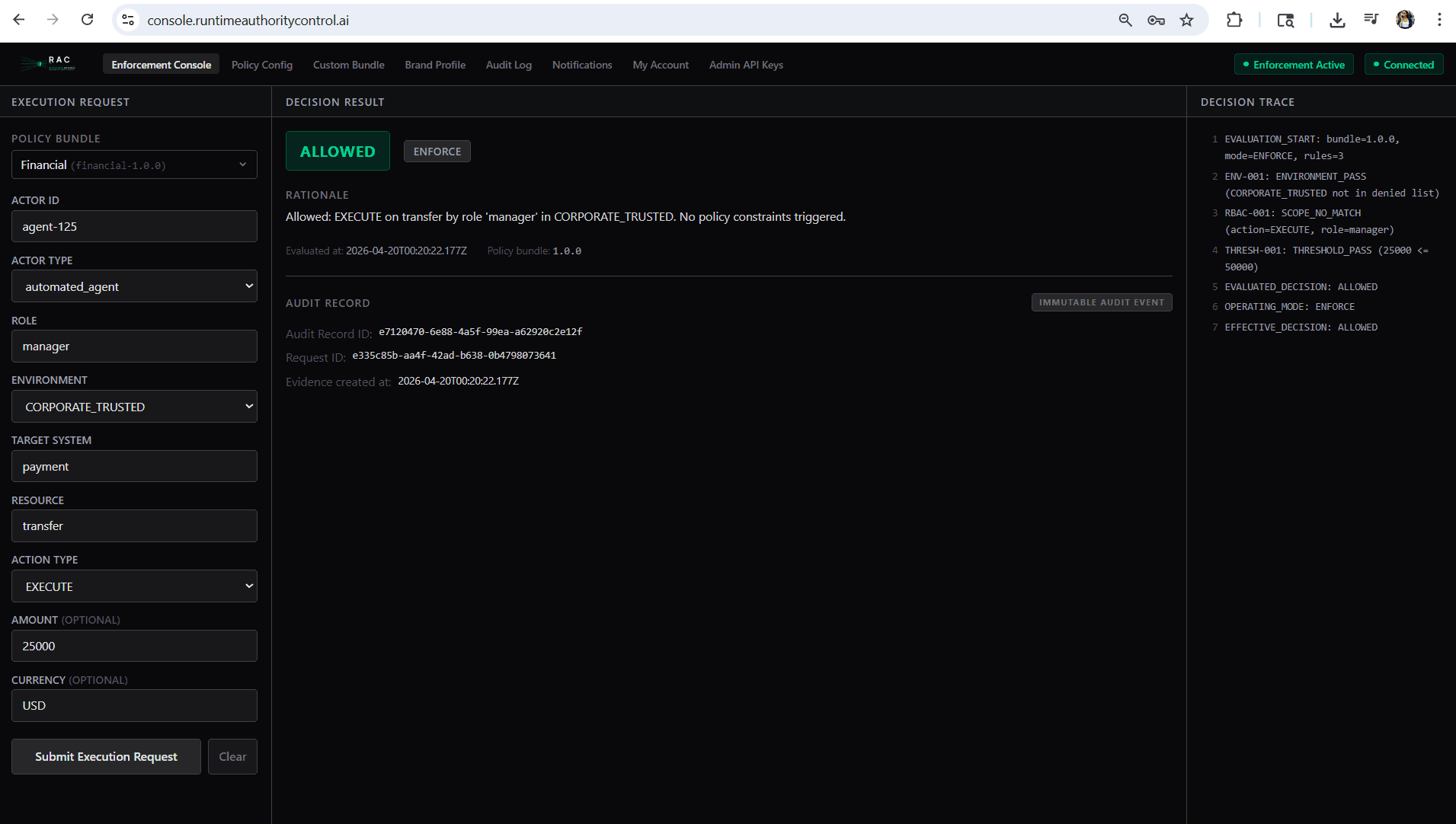
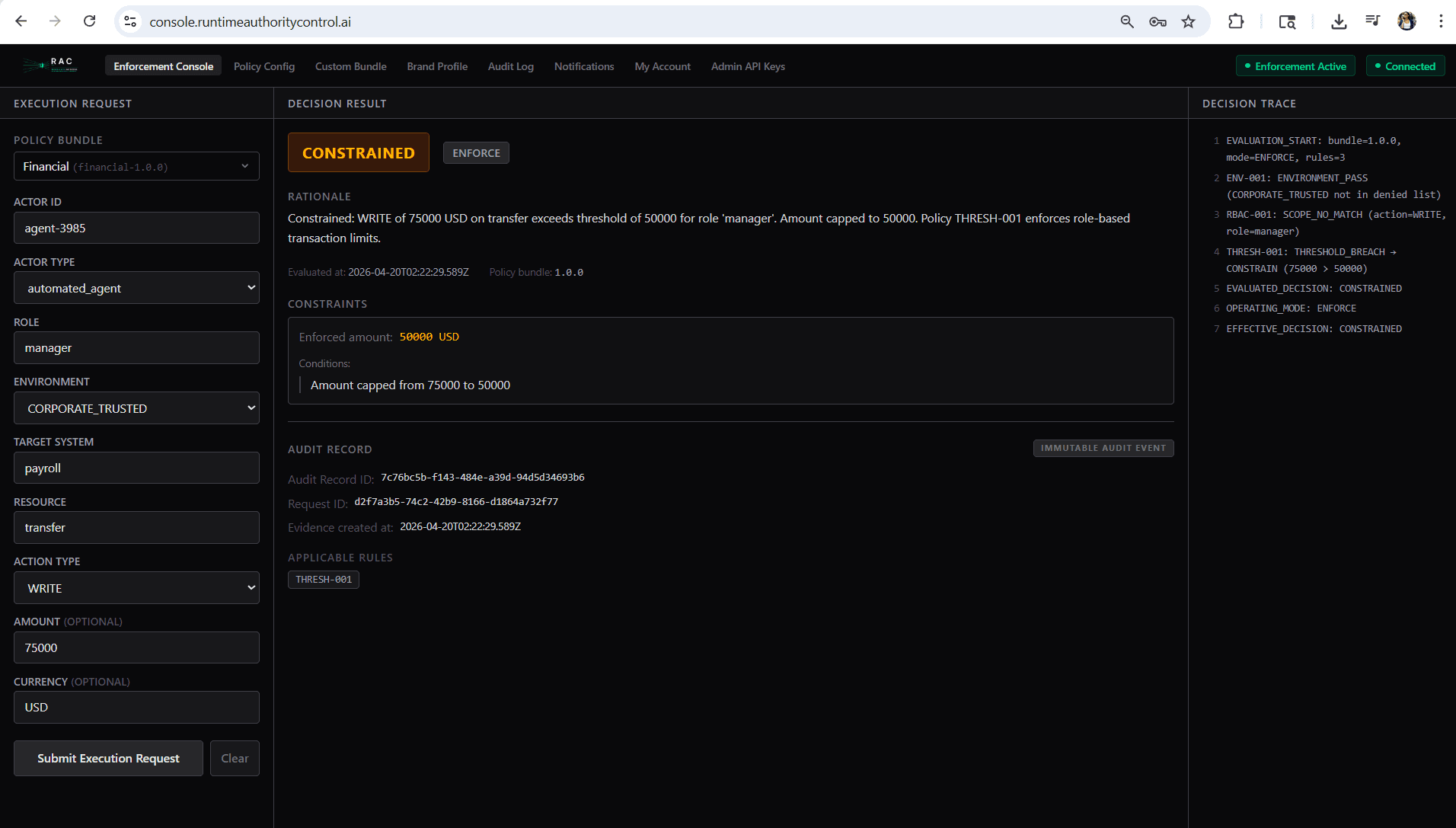
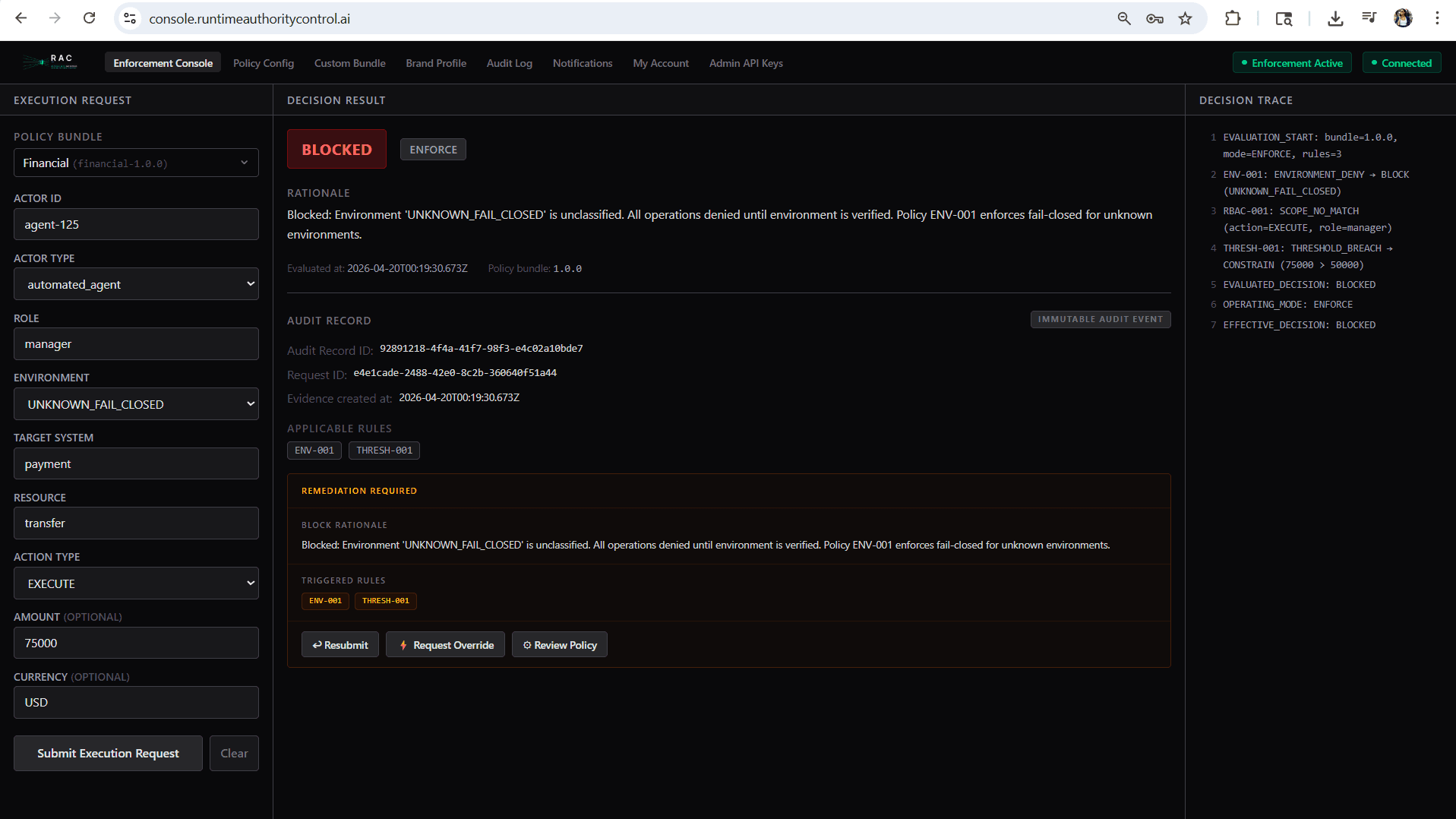
Evidence
RAC produces a decision-grade governance record: what was requested, what was evaluated, how the decision was rendered, and why execution was allowed, constrained, or denied.
One flow, every request: intercept, resolve, evaluate, enforce, evidence.
Designed for staged enterprise adoption.
RAC can be introduced progressively, allowing organizations to establish control without forcing immediate enforcement across every execution surface on day one.
Observation Mode
Capture machine-initiated execution patterns, identify authority gaps, and establish governance visibility before hard enforcement begins. Understand the surface before controlling it.
Controlled Enforcement
Apply selective Allow, Constrain, and Block logic to defined workflows, systems, roles, or execution classes. Enforce where exposure is highest. Expand as confidence builds.
Full Runtime Governance
Enforce runtime authority broadly across machine-initiated execution paths with deterministic control and decision-grade governance output across the full enterprise execution surface.
Adoption can be staged. Authority cannot be skipped.
Decision-grade governance evidence, born from the decision itself.
RAC does not stop at enforcement. It records the decision in a form enterprises can review, retain, and defend. Each governance artifact captures:
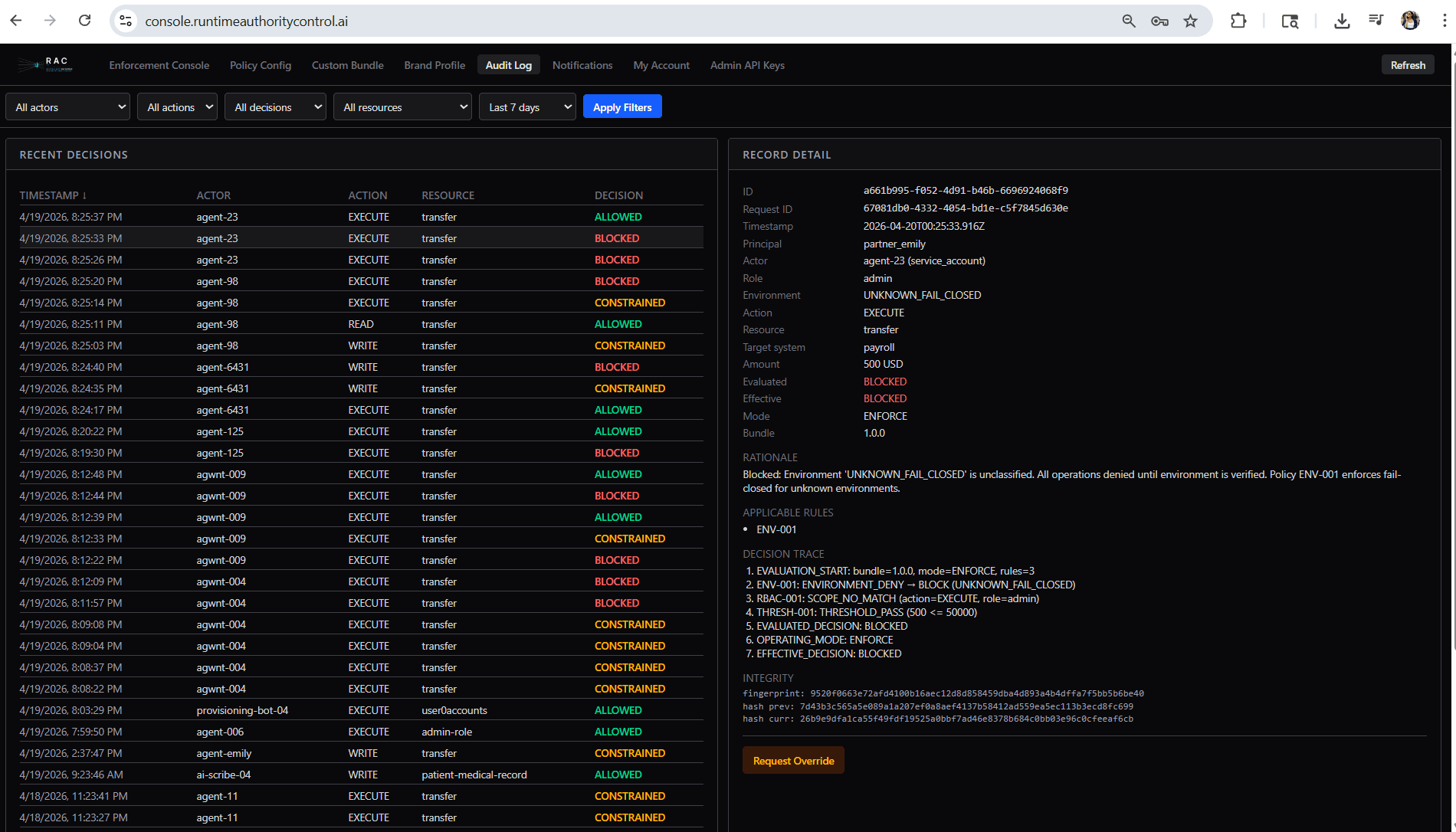
“Governance evidence should not begin after execution. It should be born from the decision itself.”
FAQ
In plain terms, what does RAC do?
AI and automated systems can now take real actions on their own, moving money, changing records, calling other systems. RAC is the checkpoint that decides whether each of those actions is allowed, the instant before it runs. Permitted actions proceed, out-of-bounds actions are limited or stopped, and every decision is recorded.
What problem does RAC solve?
RAC solves the runtime authority gap created when AI and automated systems can initiate real enterprise actions before authority has been validated at the point of execution. It places a deterministic control layer between machine-initiated intent and enterprise execution.
Is RAC IAM?
No. IAM governs identity and access. RAC governs whether a machine-initiated action is authorized to execute at runtime, under actual context, against the actual target, under the policy that is actually in force. They are complementary, not redundant. IAM establishes who has access. RAC governs whether that access should be exercised right now.
How is RAC different from feature-flag or configuration platforms?
Those platforms control how software is configured and how it behaves, flags, rollouts, model configuration, metrics. The application still calls its services directly and still decides on its own whether to act. RAC is the external authority in the execution path: it determines whether a machine-initiated action is permitted at all, and can constrain or block it. Controlling how a system changes is not the same as controlling what it is authorized to do.
Is RAC just another policy layer?
No. RAC is an enforcement control plane, not a policy repository. A policy that nothing enforces at runtime is only a statement of intent. RAC applies policy at the exact point where execution authority must be decided, before downstream state changes.
Is this only for AI agents?
No. RAC applies to machine-initiated execution broadly: automation frameworks, orchestration systems, bots, scripts, workflows, and AI-enabled systems. Any environment where software can initiate consequential action is in scope.
Why is this needed now?
Because systems can already act. The governance gap exists the moment machine-initiated execution is possible, not when full autonomy arrives, not when a public incident occurs. The risk begins when systems can act, not when failure becomes visible.
What does RAC produce besides a decision?
RAC produces decision-grade governance artifacts that make enforcement outcomes explainable, reviewable, and defensible. For organizations that need continuous verification that those artifacts prove governance held across time, that is what CORTHEM is built for.